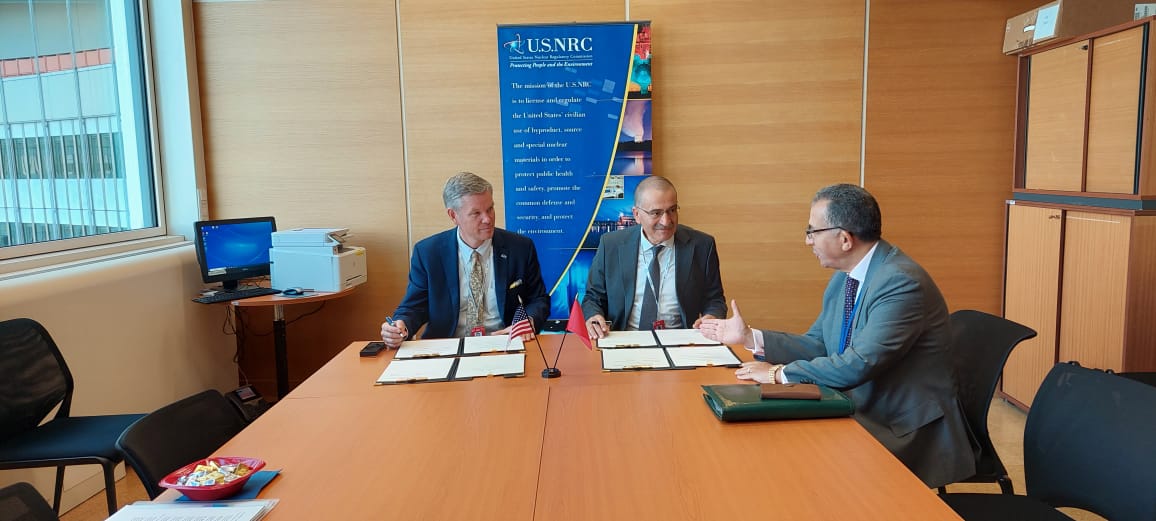
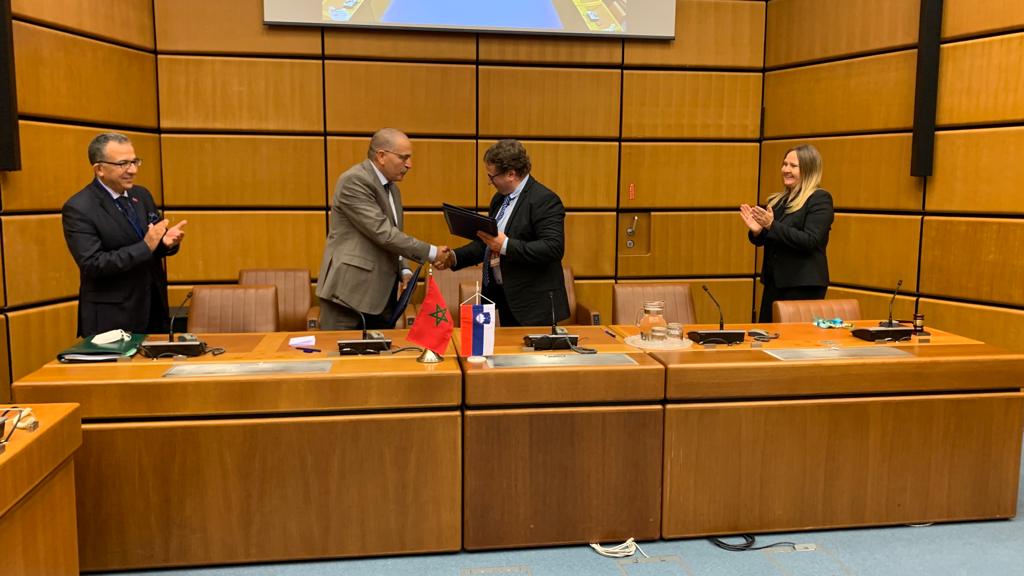
As part of the implementation of the theoretical and practical training strategy in the fields of nuclear and radiological safety and security, the Director General of AMSSNuR, Dr. Khammar Mrabit, signed, on June 9, 2021 in Settat, a partnership agreement with Mrs. Khadija Essafi, President of the Hassan Premier University of Settat (UH1).
The purpose of this agreement is to define the framework for cooperation aimed at contributing to the development and maintenance of skills in nuclear and radiological safety and security and safeguards for the benefit of students and teaching staff of UH1, in particular the Higher Institute of Health Sciences and other institutions under its supervision.
On this occasion, Dr. Mrabit stressed that this partnership is the illustration of the Royal High Will to promote vocational training and skills development in all socio-economic fields.
In this context, AMSSNuR developed and presented to its Board of Directors in November 2019 the strategy for theoretical and practical training in the fields of nuclear and radiological safety and security, recommended by the International Atomic Energy Agency (IAEA). The strategy aims to build human capacity to ensure a high level of safety and security in all facilities and activities using sources of ionising radiation over the long term.
In its approach to implementing this strategy, AMSSNuR has signed several cooperation agreements with the relevant ministries and national authorities, as well as with universities, with the aim of collaborating and carrying out joint actions within the framework of theoretical and practical training in the fields of nuclear and radiological safety and security.
Indeed, these agreements aim to strengthen skills at the national level in the fields of nuclear and radiological safety and security as well as cooperation in Africa, in accordance with the royal guidelines on professional training and skills development in all socio-economic fields.
Thus, the partnership established will cover the initial academic training of students, the training of trainers, scientific and regulatory monitoring and regional and international cooperation.
Finally, the areas of cooperation and partnership of this convention are focused on the development of training programs related to nuclear and radiological safety and security and on the conduct of studies and research, as well as on the development of the culture of nuclear safety and security and the awareness of the faculty of the commitments of the Kingdom of Morocco in terms of nuclear safeguards.