



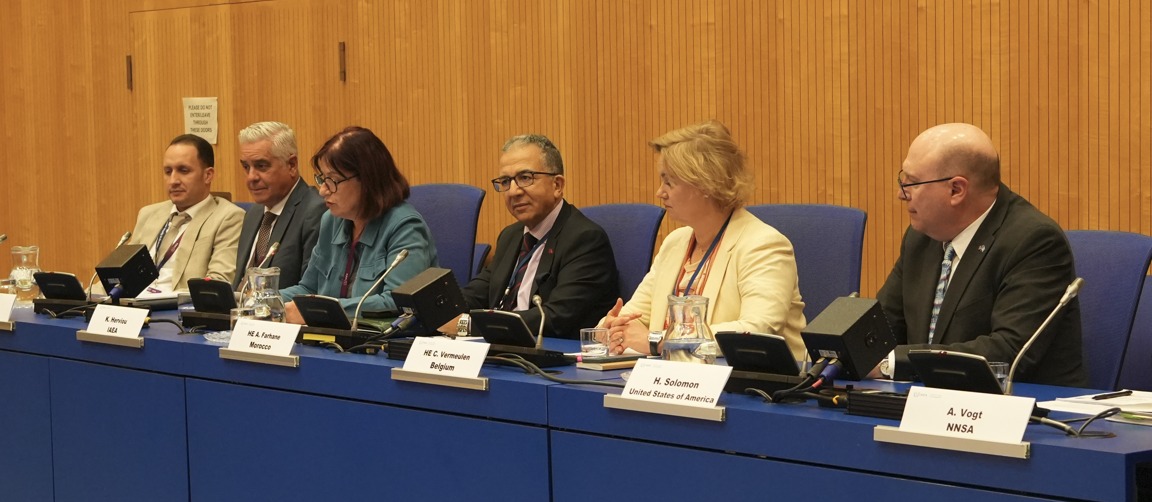
Vienna, May 11–15, 2026 – A Committed Moroccan Experience for Strengthening Cybersecurity in the Nuclear World
The Director General of the Moroccan Agency for Nuclear and Radiological Safety and Security, Mr. Saïd MOULINE, accompanied by the Secretary General of the Agency, Mr. Reda NOUR, participated in the proceedings of the “International Conference on Computer Security in the Nuclear World: Securing the Future,” organized by the International Atomic Energy Agency in Vienna, Austria, from May 11 to 15, 2026. This conference brought together competent authorities and international experts to exchange insights on emerging challenges in information security applied to the nuclear sector.
On the sidelines of this international conference, the Kingdom of Morocco organized, on Tuesday, May 12, 2026, a side event entitled “Sharing Experience on Emerging Threats of Cybersecurity and Artificial Intelligence,” dedicated to presenting the Moroccan experience in facing emerging threats related to cybersecurity and artificial intelligence.
This high-level event, chaired by the Ambassador and Permanent Representative of the Kingdom of Morocco to the International Organizations in Vienna, Mr. Azzeddine FARHANE, brought together several prominent figures, notably the Ambassador of the Kingdom of Belgium in Vienna, Ms. Caroline VERMEULEN, the Chargé d’Affaires of the Mission of the United States of America to the International Atomic Energy Agency, Mr. Howard SOLOMON, the Deputy Director General of the International Atomic Energy Agency, Ms. Karine HERVIOU, as well as representatives from international institutions and specialized bodies committed to strengthening nuclear cybersecurity.
On this occasion, the Director General of the Moroccan Agency for Nuclear and Radiological Safety and Security, Mr. Saïd MOULINE, expressed in his opening remarks his gratitude to the dignitaries who took part in this high-level event, emphasizing the importance of international cooperation in strengthening the capacities of safety and security authorities to effectively counter emerging threats. He also stressed the strategic importance of cybersecurity within the context of a constantly evolving digital environment, particularly when it concerns the nuclear field. In conclusion, he highlighted the initiatives led by the Moroccan Agency with the support of its international partners, most notably the International Atomic Energy Agency, the National Nuclear Security Administration (NNSA) of the United States of America, and the Belgian Federal Agency for Nuclear Control (AFCN).
Subsequently, the Deputy Administrator of the United States National Nuclear Security Administration, Mr. Andrew VOGT, presented the International Atomic Energy Agency’s Information Circular number 908 on the inside threat, on the occasion of its tenth anniversary, outlining the main achievements of this international working group, which brings together more than thirty countries in addition to the International Criminal Police Organization, as well as the future challenges that Information Circular 908 must address in light of growing threats. He also commended the pivotal role of the Moroccan Agency in organizing the regional event in October 2025 in Rabat on cybersecurity for French-speaking African countries, which falls within the framework of a solid and long-term cooperation between the two institutions (the Moroccan Agency and the United States Administration).
In the same context, the Secretary General of the Moroccan Agency, Mr. Reda NOUR, outlined during his presentation the national context regarding the use of nuclear and radiological applications, recalling the constant commitment of the Kingdom of Morocco to strengthening the national nuclear security framework in compliance with legally binding international instruments. He highlighted Morocco’s active role as a signatory to Information Circular 908 on the inside threat, and as a member of its international working group since its establishment in 2016. He also emphasized the efforts deployed by the Moroccan Agency over recent years in capacity building, regulatory enhancement, and regional cooperation across the African continent in the fields of cybersecurity and the responsible use of artificial intelligence.
The contribution of the Moroccan Agency for Nuclear and Radiological Safety and Security to this international conference consolidates its steadfast commitment to upgrading the national framework for nuclear and radiological safety and security, securing critical digital systems associated with vital infrastructure and sensitive facilities, and reinforcing international cooperation to meet emerging challenges related to cybersecurity in a rapidly digitalizing nuclear sector.